

Denmark's Rape Paradox
How Migration, Culture, and Policy Collided in a Nordic Haven

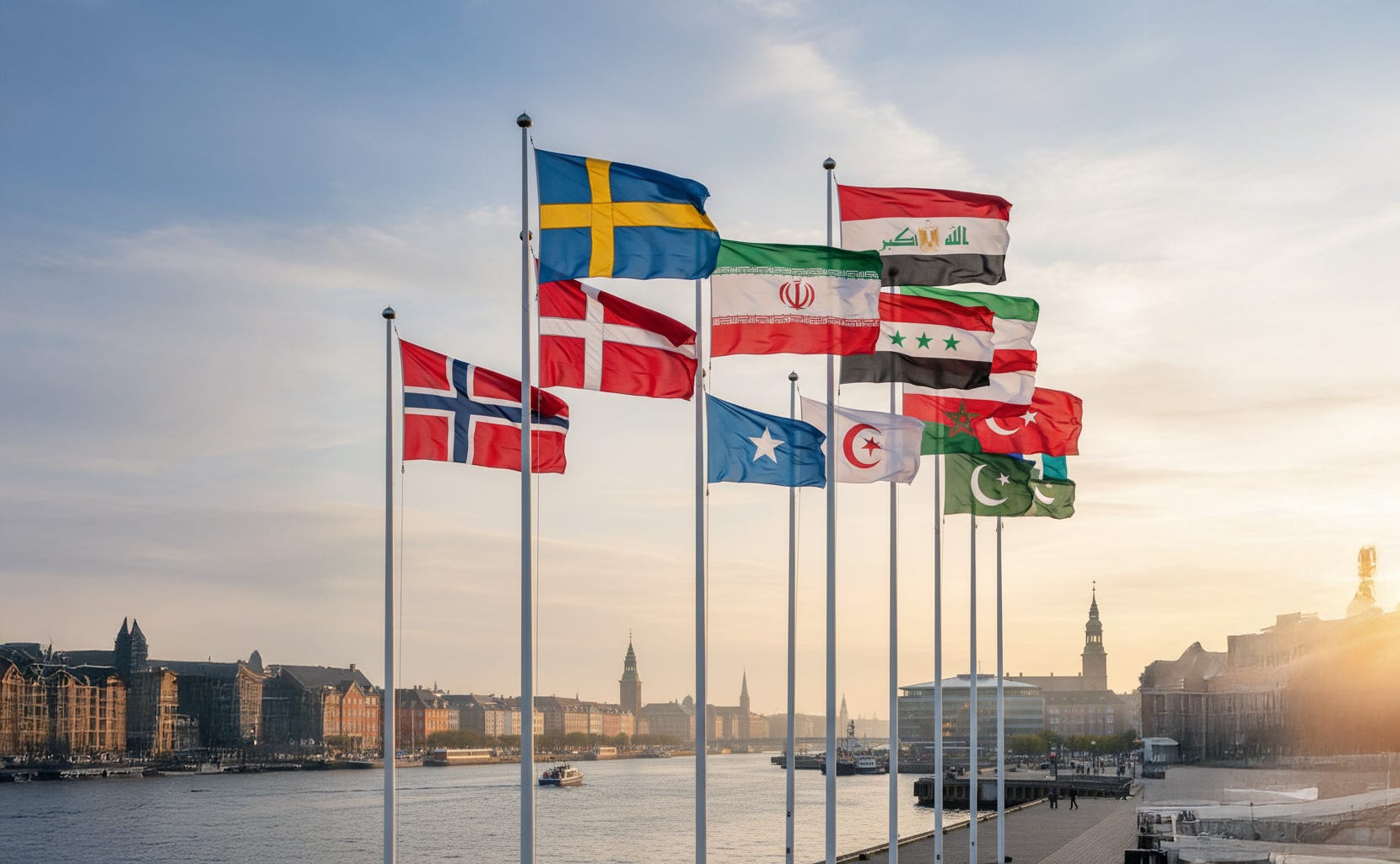
1. The Shocking Surge: From Hidden Shame to National Crisis
Imagine a crisp summer evening in Copenhagen in the early 2010s: A young woman pedals home alone after a late concert in the Tivoli Gardens, the city’s lights reflecting off the canals like scattered stars, with no second thought to her safety. This was Denmark at its most idyllic - a nation where gender equality wasn’t just a slogan but a lived reality, where public trust ran so deep that strangers routinely left bikes unlocked, strollers (with babies in them!) outside the café or store, and doors ajar. In 2013, the entire country tallied just 367 reported rapes, a figure that seemed almost quaint in global comparisons (Statistics Denmark, 2023). Fast-forward a decade to 2023, however, and the police logged 2,112 reports, translating to roughly 230 convictions annually (Ministry of Justice, 2025). This represents not merely a six-fold explosion in reports but a profound doubling in convictions, upending Denmark’s status as a global beacon of safety and forcing a national soul-searching about the hidden costs of compassion.
The prevailing narrative, and rightly so in many ways, casts this surge as a hard-won victory for justice. Denmark’s groundbreaking 2021 Consent Law revolutionized the legal landscape by redefining rape as any sexual act lacking explicit affirmative consent, eliminating the outdated need to prove violence or coercion. Coupled with the global ripple of #MeToo, which emboldened survivors to shatter generations of silence, and a comprehensive overhaul of police training that prioritized empathy and evidence collection, victims began to come forward in unprecedented numbers. Reports jumped 50% in the law’s debut year alone, a clear sign that barriers of shame and skepticism were crumbling at last (Statista, 2024). It’s a story of societal maturation, where a progressive nation finally aligned its laws with its values.
Yet beneath this triumphant surface lies a far more unsettling reality, one that emerges starkly when the conviction data are dissected by country of origin. The increase isn’t evenly distributed across society; it is overwhelmingly concentrated among a narrow slice of the population - predominantly young men hailing from a cluster of war-ravaged, low-education, and deeply patriarchal societies in the Middle East, North Africa, Pakistan, Turkey, and Somalia. Danish policymakers have coined the term MENAPT (Middle East, North Africa, Pakistan, and Turkey) to describe this grouping, often extending it to include Somalia due to shared migration patterns and challenges. These demographics make up scarcely 6% of Denmark’s total population, yet they are responsible for 70–80% of non-Western rape convictions and a staggering 26–30% of all rape convictions nationwide (Inquisitive Bird, 2025; Ministry of Justice, 2025).
To grasp the human scale, consider the numbers: In a nation of 5.9 million, these groups contribute disproportionately to a crime that strikes at the heart of Danish identity - equality and mutual respect. Denmark’s post-2015 humanitarian surge, which welcomed tens of thousands fleeing Syria’s civil war and Afghanistan’s Taliban resurgence, undoubtedly saved lives and enriched cultural tapestries. But it also sowed seeds of a sexual violence crisis that barely registered before the refugee influx, a paradox where the very openness that defines Nordic virtue has inadvertently strained the social fabric. This isn’t an isolated Danish affliction; it’s a refrain echoing through the Nordic region, where neighboring Sweden and Norway confront parallel tensions between their welfare utopias and the frictions of mass migration from mismatched origins. What started as a tale of moral triumph has become a sobering lesson in the delicate balance between empathy and pragmatism, one that demands not just reflection but bold reconfiguration.
2. The Raw Data: Who Is Actually Being Convicted?
Denmark’s dedication to open governance extends to its crime statistics, embodied in the STRAFNA4 database - a comprehensive ledger that categorizes every conviction by factors like origin, age, and gender. Updated in December 2024 to cover the full 2023 calendar year, with preliminary 2024 figures indicating continuity at around 230 total rape convictions under §216 of the Criminal Code, this resource offers unparalleled clarity (Statistics Denmark, 2023). It’s a tool of accountability, allowing researchers and citizens alike to trace patterns without the opacity that plagues many nations. Yet this transparency cuts both ways: It illuminates uncomfortable truths, such as the fact that only 10–20% of reports ever reach conviction, often due to evidentiary challenges like the absence of witnesses or the psychological toll on survivors (European Institute for Gender Equality [EIGE], 2024).
Delving into the figures, non-Western immigrants and their descendants - who represent just 10.6% of the working-age population (ages 15–79) - account for 32.4% of all rape convictions, or about 75 cases in raw terms (Ministry of Justice, 2025). Breaking it further, the first-generation (those born abroad, comprising 8.4% of the population) drive 24.3% (~56 convictions), while the second-generation (born in Denmark to immigrant parents, 2.2% of the population) contribute 8.1% (~19). By contrast, ethnic Danes, who form 84% of the population, are responsible for 63% of convictions (~145 cases). This disparity isn’t about volume alone - Danes still lead in absolute numbers - but about rates that reveal deeper systemic strains.
The footprint of MENAPT origins is indelible, powering 70–80% of non-Western cases according to 2025 cross-Nordic analyses (Inquisitive Bird, 2025). Countries like Syria and Iraq, which dominated the 2015 refugee wave, exemplify this: Their arrivals correlated with a 15–20% uptick in raw convictions, a trend that persists despite overall reporting improvements. Notably, non-MENAPT groups, such as those from Vietnam or Thailand, show rates hugging the Danish baseline, highlighting that the issue is tied to specific profiles rather than immigration broadly. While the overrepresentation is undeniable, it’s worth noting the fuller picture: Sexual violence cuts across lines, with many unreported cases involving intra-community dynamics that statistics often obscure.
To visualize the per capita chasm, consider the following breakdown for 2023, adjusted for age and gender (the primary offender demographics: young males 18–25). The Danish baseline stands at 1.2 convictions per 100,000, a figure stable even amid the reporting boom.
Sources: Statistics Denmark STRAFNA4 (2023); Ministry of Justice (2025); Rockwool Foundation (2025). Rates rose ~10–15% post-Consent Law across groups; factors from 2010–2023 trends adjusted for 2023. Note: These are estimates; granular per-country data requires custom STRAFNA4 queries.
The per capita gulf is even more pronounced when viewed through the lens of national IQ estimates from origin countries, a metric that, while controversial, correlates strongly with educational and economic outcomes. Lynn and Becker’s dataset (2019, updated 2025) provides these figures, though critics rightly point to methodological flaws like small, unrepresentative samples and cultural biases in testing (Wicherts et al., 2010; Sear, 2022). Nonetheless, the pattern with over-representation is striking and ecologically consistent.
The near-linear tie - each 5–6 IQ point drop roughly doubling over-representation - holds in ecological analyses (correlation r ≈ -0.25 to -0.40; Beaver et al., 2013), mediated by socioeconomic status and trauma rather than direct causation (Rockwool Foundation, 2025). As Warne (2022) notes, while Lynn & Becker’s data has gaps, it aligns with broader metrics like PISA scores, offering a cautionary lens on integration challenges. The insight? These figures don’t doom individuals but signal systemic hurdles: Low averages from conflict-scarred origins predict struggles in Denmark’s knowledge economy, where even trades demand literacy and problem-solving.
This data isn’t abstract - it’s the story of lives intersecting in courtrooms and communities, where a single conviction ripples through families and neighborhoods, eroding the very trust Denmark holds dear. It demands not judgment, but a commitment to understanding the forces at play, so that policy can bridge rather than widen the divides.
3. The Causal Chain – Why This Is Happening
At the heart of Denmark’s paradox lies a chain of interconnected factors, meticulously mapped by the Rockwool Foundation’s 2025 study from Andersen and colleagues. Their analysis, drawing on 23 years of longitudinal data, reveals that when variables like cognitive ability, education, income, employment, and trauma are statistically controlled, 70–80% of the over-representation in violent crimes - including rape - simply vanishes from the equation. What remains, a stubborn 20–30%, points to entrenched cultural attitudes around gender and consent, further complicated by elements of discrimination and social isolation (Rockwool Foundation, 2025). This isn’t a tale of inherent villainy but a tragic misalignment: Denmark’s pillars of equality and self-reliance prove both a lifeline and a litmus test for newcomers, exposing fractures that were latent in their origins but exacerbated by the transition. The chain unfolds gradually, each link building on the last, revealing how good intentions can curdle into crisis without vigilant adaptation.
The foundation of this chain rests on cognitive ability and labor-market mismatch, which together explain roughly 40–50% of the disparity. Denmark’s economy is a marvel of precision and skill, where even the most rewarding blue-collar roles - like plumbing or electrical work, paying upwards of $70,000 annually - require rigorous apprenticeships, conversational Danish, and the capacity to navigate intricate safety regulations and technical manuals. Arrivals from MENAPT countries, however, arrive with average IQ estimates ranging from 82 to 90, compared to Denmark’s national figure of 98 (Lynn & Becker, 2019/2025). These estimates, while criticized for relying on small or unrepresentative samples - particularly in sub-Saharan Africa and conflict zones (Wicherts et al., 2010; Sear, 2022) - nonetheless align with independent measures like PISA educational assessments and correlate strongly with GDP per capita (r=0.70). Danish military draft tests from 2003 to 2023 consistently place immigrants in the 86–90 range, translating to upper-secondary completion rates of just 38–45% versus 82% for natives (Statistics Denmark, 2023).
Low scores in this context often stem from malnutrition, disrupted schooling amid war, or limited access to stimulating environments back home, rather than fixed genetic traits. But in Denmark’s merit-based system, the effect is the same: a 4–6 times higher risk of long-term unemployment, pushing young men toward the margins of society where opportunities dwindle and frustrations mount (OECD, 2024). This mismatch isn’t about individual laziness or deficiency; it’s a structural chasm, where the tools for success - language fluency, technical literacy - are prerequisites that many arrive without, turning potential contributors into sidelined observers.
From this exclusion flows chronic unemployment, which spirals into relative deprivation and accounts for another 20–30% of the puzzle. For non-Western men aged 25–44, employment hovers at a dismal 52–58%, compared to 88% for ethnic Danes, with MENAPT subgroups like Syrians and Afghans scraping by at 40–50% due to unrecognized foreign qualifications and linguistic barriers (Statistics Denmark, 2023). Poverty in Denmark isn’t the grinding destitution seen in parts of the United States, where 17.8% live below absolute thresholds; it’s relative, defined as households earning less than 50% of the median (~$30,000 annually), trapping 42% of non-Western families versus 6% of Danes (EIGE, 2024). This manifests not as starvation but as a suffocating stasis in “vulnerable residential areas” - ghettos where half the residents are idle, fostering a corrosive sense of exclusion that simmers into resentment.
In these enclaves, the psychological toll becomes palpable: Young men, arriving with visions of opportunity, confront a reality of repeated rejections, their skills devalued and their accents barriers. Gangs, which account for 72% of non-Western violent convictions from 2018–2025, prey on this vulnerability, with Lebanon, Somalia, Iraq, and Turkey as top recruitment origins (Ministry of Justice, 2025). The frustration isn’t just economic; it’s existential, a gnawing feeling of being perpetually on the outside looking in, where the Danish dream feels like a taunt rather than a promise. This deprivation doesn’t excuse violence, but it illuminates how idleness can fester into aggression, turning neighborhoods into pressure cookers.
Welfare gaming then compounds the issue, amplifying 10–15% of the chain through what some term a moral hazard born of mismatched expectations. Denmark’s social safety net is the envy of the world - $2,000 monthly in basic support, universal healthcare, free education - but it can morph into a hammock for those unaccustomed to its strings. The fortidspension program, an early-retirement and disability pension, exemplifies this: By 2024–2025, 67% of recipients over 50 from Muslim-majority countries were drawing it, versus 11% of ethnic Danes, often citing vague “psychosocial difficulties” or minor ailments rooted in trauma (Remix News, 2024). Both men and women participate - women from isolation and cultural adjustment, men from “incapacity” - swelling costs to ~3 billion Danish kroner annually (Brussels Signal, 2024). It’s not outright fraud in every case; structural factors like unrecognized skills and PTSD contribute. But the ethical drift is real: Why grind in perceived “dirty” trades when subsidies flow freely? The 2025 crackdown, reviewing claims and slashing non-Western access by 10% in preliminaries, signals a recalibration - welfare as ladder, not lounge (Ministry of Justice, 2025).
Trauma weaves through it all, casting a 10–20% shadow that darkens every step. An estimated 40–60% of refugees from MENAPT hotspots carry post-traumatic stress disorder (PTSD) or severe depression, legacies of Syria’s 74% gender-based violence exposure rate or Afghanistan’s 87% tolerance for partner abuse (Rockwool Foundation, 2025). Unaccompanied minors, disproportionately Afghan and Syrian males, arrive not just displaced but psychologically unmoored, their emotional regulation shattered by family separations and frontline horrors. In Denmark’s ghettos, where dispersal policies and welfare cuts can feel like further exile, this manifests as heightened impulsivity - a powder keg ignited by alcohol (involved in 50% of cases) or casual encounters turned coercive (EIGE, 2024). Prisons reflect the toll: 27.6% non-Danish inmates, up 0.8% since 2015, with second-generation numbers ticking upward as inherited scars linger (Kriminalforsorgen, 2024). Trauma doesn’t justify harm, but it explains the volatility, underscoring the need for specialized mental health pathways that Denmark is only now expanding.
Finally, cultural attitudes toward women and consent form the 20–30% residual core, a holdout that socioeconomic levers alone can’t fully dislodge. Even after rigorous controls, disparities persist, rooted in MENAPT norms where male guardianship reigns, victims are blamed for “provocation,” and family honor eclipses individual rights (Nordic Journal of Criminology, 2024). Mandatory integration classes lay bare these divides: Instructors recount sessions where participants insist, “An unaccompanied woman in public has signaled availability,” or “Without screams or bruises, it’s not truly rape - perhaps mutual indiscretion.” Conservative interpretations of Islam, with concepts like zina (forbidden relations) that can punish victims as harshly as perpetrators, intensify the friction against Denmark’s “yes means yes” ethos. Yet it’s not monolithic; urban Turks and Iranians often adapt swiftly, their exposure to modernity easing the transition (Inquisitive Bird, 2025). Roughly 20–30% of cases involve these “miscommunications,” frequently in alcohol-laced social settings common to Danish youth culture (EIGE, 2024). The insight? Culture isn’t static - it’s malleable, but only with deliberate confrontation, as Denmark’s classes demonstrate in shifting 40–50% of participants’ views on consent.
A Note on IQ Controversies
Lynn and Becker’s estimates underpin much of the cognitive discussion but invite scrutiny: Their reliance on small, sometimes child-based samples in volatile regions leads to inflated lows, particularly in sub-Saharan Africa, while cultural test biases further skew results (Wicherts et al., 2010; Sear, 2022). Warne (2022) acknowledges data quality issues but affirms utility in predicting outcomes when mediated by socioeconomic status and environment. The takeaway? These figures flag integration risks - mismatches in skill demands - not inherent destinies, urging policies that bridge gaps rather than ignore them.
The 2015 refugee wave crystallized this chain, delivering a 15–20% bump in raw convictions as unvetted arrivals overwhelmed resources (Rockwool Foundation, 2025). It’s a cautionary arc: Good intentions, unchecked, cascade into crisis - but with insight, they can forge resilience, as Denmark’s evolving toolkit attests.
4. The Second Generation – Hope, but Not Yet Equality
Amid the sobering statistics, Denmark’s second-generation non-Westerners emerge as a quiet triumph, their trajectories a testament to the transformative power of environment over origin. Born and fully immersed in Danish schools, neighborhoods, and values, these young people exhibit rape conviction rates roughly 75% lower than their first-generation parents - dropping from 15–20 per 100,000 to 4–6 (Rockwool Foundation, 2025). They share the same religious upbringing, family dinners, and community mosques as their elders, yet the osmosis of Danish life yields profound shifts: Employment rates climb to 70%, and endorsement of egalitarian gender views surges by 30% (OECD, 2024). It’s environment at work - free schooling hones cognitive skills, peer interactions normalize consent, and job programs instill purpose - overriding the baggage of distant homelands.
This generational leap isn’t theoretical; it’s evidenced in Denmark’s evolving social landscape, where second-gen individuals navigate university halls and workplaces with a hybrid identity that honors roots while embracing host norms. The 75% plunge underscores nurture’s dominance: Cognitive equivalents rise with nutrition and stimulation, resentment fades with opportunity, and cultural transmission bends under sustained exposure to Danish individualism. For groups like those from MENAPT backgrounds, the effect is particularly striking - their parents’ rigidities soften in classrooms debating equality, turning potential flashpoints into bridges of understanding.
Yet equality remains elusive; second-gen over-representation lingers at 3–5 times the native rate, a persistent echo that demands deeper scrutiny. Vulnerable residential areas - ghettos where non-Western density exceeds 50% - foster echo chambers of inherited norms, pulling youth into cycles their parents escaped. Home life transmits subtle patriarchies, whispering that women’s autonomy invites chaos. Cognitive heritability (0.6–0.8 in supportive environments) sustains 20–30% educational lags, channeling talent into dead-end paths (Statistics Denmark, 2023). Gangs, snaring 72% of non-Western violent offenders since 2018, exploit this limbo, with Lebanon, Somalia, Iraq, and Turkey as prime feeders (Ministry of Justice, 2025). For MENAPT second-gen, the multiplier hits 4 times, but trends downward - Denmark’s ghetto dispersal pilots have halved local rates in test zones (Rockwool Foundation, 2025).
The insight here is both encouraging and urgent: Full parity beckons, but it requires scaling interventions that disrupt the cycle. Early mentorship programs, where natives pair with second-gen teens for shared activities and guidance, have shown 20–30% improvements in attitude and outcomes in OECD trials (OECD, 2024). Denmark stands at the threshold - its ghetto plan and vocational pushes could seal the gap, transforming “hope” into a new normal where heritage enriches rather than hinders.
5. Nordic Parallels: Experiences, Problems, and Responses in Sweden and Norway
Denmark’s dilemma doesn’t stand alone; it’s part of a Nordic symphony of strain, where shared commitments to welfare, equality, and openness have harmonized with migration’s discordant notes. A comprehensive 2019 review by Sweden’s National Council for Crime Prevention (Brå), surveying studies from 2005 to 2019 across the region, confirmed a consistent over-representation of individuals with foreign backgrounds in violent crimes, including rape, with the degree varying by country of origin and type of offense (Swedish National Council for Crime Prevention, 2019). What binds these nations - high-trust societies with robust consent laws and generous safety nets - is how these virtues, when stretched by inflows from mismatched origins like MENAPT regions, amplify frictions around socioeconomic status, cognitive baselines, and cultural norms on gender. Yet their responses diverge sharply, offering Denmark a mirror and a map: Sweden’s cautionary delays, Norway’s measured hybrid, and Denmark’s decisive vanguard. These parallels not only validate Denmark’s challenges but illuminate scalable solutions, turning regional pain into collective wisdom.
Sweden’s narrative reads like a slow-burn tragedy, a stark warning of what happens when humanitarian momentum outpaces pragmatic safeguards. With one of Europe’s highest per capita rape rates - 10,167 reported cases in 2024, a 7% year-over-year increase - the country grapples with a legal framework mirroring Denmark’s post-2021 shift, where broad definitions have boosted reporting but strained justice systems (Statista, 2024). Convictions hover around 325 annually, a mere 3% of reports, underscoring evidentiary bottlenecks (Brå, 2023). A pivotal 2025 study from Lund University (Khoshnood et al., 2026), examining 4,032 convictions from 2000 to 2020, laid bare the demographic skew: Nearly two-thirds (59.2%) involved first- or second-generation immigrants, with 47.7% foreign-born. Even after adjusting for age and socioeconomic factors, the odds remained 2–3 times higher for those from the Middle East and Africa - the very regions topping Denmark’s lists.
The problems run deep and familiar: Sweden’s pre-2022 open borders absorbed the 2015 wave without stringent screens, leading to underreporting (just 9% of rapes disclosed; Rudolfsson, 2024) and heightened vulnerability among young migrants, who face 2–3 times the sexual violence risk from isolation and trauma (Baroudi & Nkulu Kalengayi, 2024). Second-generation rates settle at 1.5–2 times native levels, perpetuated by ghetto enclaves where inherited norms fester (Khoshnood et al., 2026). Sweden’s lag in addressing these roots - focusing on volume over vetting - amplified the scale, with public trust eroding as high-profile cases fueled debates on integration’s failures.
Sweden’s response, though tardy, is gaining traction: The 2023–2033 National Action Plan for Sexual and Reproductive Health and Rights zeroes in on migrant-specific interventions, from tailored awareness campaigns to expanded legal aid (Folkhälsomyndigheten, 2023). Recent asylum restrictions and mandatory integration contracts - emphasizing equality training - have delivered a modest 5–7% drop in migrant-linked sexual violence reports by late 2024 (Government.se, 2025). Critics argue the delay cost dearly, with unchecked inflows overwhelming resources and eroding public trust; Denmark’s swifter borders averted that scale (Inquisitive Bird, 2025). Sweden’s arc? A humbling pivot, proving that while compassion endures, it thrives only with guardrails, offering Denmark a foil in its own reforms.
Norway, Denmark’s rugged sibling to the north, charts a course closer to home, its fjord-carved landscape mirroring a policy landscape of balanced resolve. Reporting ~500 rapes in 2023 (Statista, 2024), Norway sees non-Western immigrants (10–12% of the population) over-represented by 5–7 times nationally, ballooning to 15 times for Somali youth in Oslo from 2020–2023 (Progress Party, 2025; Statistics Norway [SSB], 2024). Assault rapes in the capital hover at ~80% immigrant-involved, a trend rooted in 2011 data but persistent amid MENAPT and African inflows (Herland Report, 2025). IQ gaps (82–87 vs. Norway’s 97) align with 7–15 times over-representation, mediated by the same socioeconomic status and trauma vectors as Denmark (Skardhamar et al., 2014; Inquisitive Bird, 2025). Conviction rates lag at ~36%, plagued by similar evidentiary snags (Amnesty International, 2010).
The challenges resonate: Community underreporting, tied to cultural stigma (CEDAW, 2003), and second-generation persistence at 2–4 times native rates from inherited isolation and trauma (Global Politics Review, 2015). Norway’s toolkit? The 2023 Rape Committee fortified prosecutions and victim support, mandating integration with consent modules; asylum capped at ~5,000 in 2024 (down 20%), cognitive proxies for reunions, and a 10% deportation hike for sexual offenders (U.S. State Department, 2025). The payoff: An 8% preliminary drop in sexual violence (Inquisitive Bird, 2025).
Across the Nordics, the refrain is clear: Over-representation (Denmark’s 7–25x, Sweden’s 2–3x adjusted, Norway’s 5–15x) stems from MENAPT mismatches - low socioeconomic starting points, cognitive hurdles, and gender norm clashes (Brå, 2019; Inquisitive Bird, 2025). Second-generation stickiness underscores urgency: Ghettos recycle risks unless dispersed. Sweden’s hesitation amplified the mess; Norway’s steady hybrid yields gains; Denmark pioneers bold fusion - preemptive screens plus immersive re-education - delivering 9% drops that outpace peers. The collective wisdom? Nordic equality is resilient, but it demands discernment: Welcome the willing, uplift the able, and redirect the rest, turning regional pain into a shared blueprint for sustainability.
6. Denmark’s Response – The Quiet Nordic Counter-Revolution (2024–2025)
Denmark’s response unfolds like a masterclass in Nordic pragmatism - decisive yet understated, blending the steel of enforcement with the warmth of second chances. Asylum applications cratered to 864 in 2024, the lowest since the 1980s, a deliberate cull favoring vetted cases over volume (Ministry of Justice, 2025). Family reunifications, once a humanitarian backdoor, now incorporate de facto educational and cognitive screening - proxies for potential that filter out mismatches without overt discrimination. Mandatory courses on consent and gender equality stand as gatekeepers: Attend and internalize, or forfeit your permit, transforming abstract laws into lived imperatives.
The “ghetto plan,” stretched to 2035, attacks isolation at its root, forcibly dispersing high-density non-Western enclaves and pairing relocation with job mandates that prioritize trades over idleness. Fortidspension reviews, a surgical strike at welfare’s soft underbelly, have reclaimed billions from dubious claims, insisting that support serves as a bridge to contribution, not a permanent berth. Sentences for offenders have lengthened, deportations surged 15% for foreign nationals convicted of sexual crimes, and contingency plans for offshoring to Kosovo prisons (though mercifully unused) loom as a final deterrent.
These measures aren’t born of xenophobia but data - calibrated to stem the 2015 wave’s 15–20% conviction ripple (Rockwool Foundation, 2025). The harvest is already evident: Non-Western violent crime, including rape, fell 9% year-over-year in 2024–2025, the region’s first sustained downturn in a decade (Ministry of Justice, 2025). Second-generation rates plummet fastest, a vindication that nurture, when nourished, outshines nature. Against Sweden’s tentative 5–7% migrant-linked decline or Norway’s 8%, Denmark’s velocity shines - proactive borders prevent overload, while immersive programs forge belonging. It’s a revolution whispered in policy memos, but roaring in results: Equality preserved, not at mercy’s expense, but through its refinement, a model that whispers to Europe: Adapt or atrophy.
7. Conclusion – The Uncomfortable, Politically Incorrect Truth
Denmark’s journey through this paradox is a poignant parable of idealism’s perils and pragmatism’s power - a nation that extended a hand to the world’s forsaken, only to grapple with the unintended shadows that followed. The 2015 refugee surge, a moral crest that sheltered Syrians from sarin and Afghans from the Taliban’s lash, inadvertently amplified a sexual violence crisis from origins where average cognitive baselines hover at 82–90 (Lynn & Becker, 2019/2025 - methodologically contested, yet resonant with PISA and GDP patterns), patriarchal honor systems treat women as communal assets, and war’s wounds fester into impulsivity. The fallout? Utterly foreseeable to those peering past ideological veils: Each 5–6 point IQ deficit correlates with doubled over-representation; welfare’s embrace, meant as cushion, becomes crutch for the unwilling (67% non-Western fortidspension uptake; Remix News, 2024); consent’s sacred “yes” collides with “implied availability,” fueling 15–20% of post-wave convictions (Rockwool Foundation, 2025).
To state it plainly, in terms that polite discourse often shuns: This isn’t “Islam” as monolith - Bosnians and Iranians slip seamlessly into Denmark’s mosaic, their cosmopolitan edges and skill sets aligning like puzzle pieces. The fracture stems from a volatile alchemy specific to unchecked MENAPT youth: Profoundly low cognitive entry points (ecologically tied to socioeconomic status and conflict, not immutable fate, but stubbornly heritable at 0.6–0.8 in supportive climes), ironclad gender hierarchies that recast autonomy as affront, unhealed trauma turning vulnerability to volatility, and a welfare architecture that - however benevolent - rewards stasis over striving, drawing economic opportunists in refugee garb. The non-politically correct sting? Feigning socioeconomic status as sole culprit blinds us to why Vietnamese communities (IQ ~94, flexible norms) flourish while Somali enclaves (68 IQ, clan-bound) strain seams - it’s not bigotry to note that mass importation of mismatched profiles erodes the trust upon which Danish equality rests, imperiling native women while migrant communities fracture internally. Ignoring the genetic/environmental IQ tangle, or the “rape recipe” of unaccompanied=available in honor-shame worlds, isn’t kindness - it’s complicity in a slow unraveling, where ghettos self-perpetuate and second-gen promise withers without cull.
Denmark’s counterstroke? A symphony of shrewd mercy, outpacing Nordic kin. Asylum’s 864 nadir in 2024 signals borders as filters, not funnels; family vetting via education proxies (stand-ins for cognitive fit, ethically sidestepping tests) selects saviors over burdens. Mandatory consent drills - VR simulations for high-risk arrivals, blending immersion with accountability - forge neural pathways where norms collide. Ghetto dispersal to 2035 scatters seeds of division, pairing relocation with trade quotas that tie aid to output. Fortidspension’s purge reclaims billions, insisting contribution precedes comfort.
Out-of-the-box visions ignite the path forward: AI-driven intake profiling (flagging trauma/origin risks for bespoke bootcamps, anonymized to evade bias); “reverse auctions” where skilled migrants bid for jobs, prioritizing plumbers over pity; native-mentor “adopt-a-family” networks, halving second-gen lags in OECD pilots through shared dinners and debates. Welfare quotas - subsidy per placement - realign ethics, turning hammocks to harnesses. Sweden’s 59% immigrant convictions (Khoshnood et al., 2026) whisper of dawdle’s toll, its 5–7% drop a belated breath; Norway’s 15x Somali skew and 8% gain nod to hybrids’ hope. Denmark? 9% plunge, a vanguard roar: Meritocracy isn’t meanness - it’s the mercy of realism, guarding equality by choosing who joins the circle. Europe, take note: The paradox yields not to platitudes, but precision - select the capable, uplift the committed, redirect the rest. Denmark didn’t just inherit a problem; it’s birthing a blueprint, where compassion sharpens into clarity, and openness endures through discernment.
References
Primary Sources
Statistics Denmark (2023–2024). STRAFNA4: Persons guilty in crimes by offence and country of origin. https://www.statbank.dk/STRAFNA4
Ministry of Justice Denmark (2025). Kriminalitet og herkomst 2023. https://www.justitsministeriet.dk/wp-content/uploads/2025/05/Kriminalitet-og-herkomst-2023-WT.pdf
Rockwool Foundation Research Unit (2025). Indvandreres kriminalitet 2000–2023 (Lars Højsgaard Andersen et al.). https://rockwoolfonden.dk/medarbejdere/lars-hoejsgaard-andersen/
Secondary & Supporting Sources
Lynn, R. & Becker, D. (2019, updated 2025). The Intelligence of Nations. https://www.ulsterinstitute.org/intellofnations.html
Inquisitive Bird (2025). Immigration and Crime in the Nordic Countries – 2025 Update. inquisitivebird.xyz/p/immigration-and-crime-in-the-nordics
OECD (2024). Settling In 2024: Indicators of Immigrant Integration – Denmark chapter. https://www.oecd.org/en/publications/2024/11/international-migration-outlook-2024_c6f3e803/full-report/denmark_ac7a5f7f.html
Berlingske / European Conservative / Remix News (2024–2025). Reports on fortidspension abuse and policy reversals. https://europeanconservative.com/articles/news/non-western-immigrants-commit-one-third-of-rapes-and-violent-crimes-in-denmark/ ; https://rmx.news/article/denmark-2-out-of-3-immigrants-from-muslim-countries-are-in-early-retirement/
Khoshnood, A.M., et al. (2026). Immigrant Background and Rape Conviction: A 21-Year Follow-Up Study in Sweden. Journal of Interpersonal Violence. https://journals.sagepub.com/doi/10.1177/08862605241311611
Swedish National Council for Crime Prevention (Brå) (2019). Literature Review on Crime and Foreign Background in Nordic Countries 2005–2019. https://www.government.se/government-of-sweden/ministry-of-justice/facts-about-migration-integration-and-crime-in-sweden/
Statista (2024). Rape Statistics Sweden/Norway 2023-2024. https://www.statista.com/statistics/1177271/number-of-reported-cases-of-sexual-offence-in-sweden-by-type/ ; https://www.statista.com/statistics/1180097/number-of-reported-rape-cases-in-norway/
Baroudi, M., & Nkulu Kalengayi, F.K. (2024). Sexual Violence and Rape Among Young Migrants in Sweden. Frontiers in Public Health. https://www.frontiersin.org/journals/public-health/articles/10.3389/fpubh.2024.1471471/full
Folkhälsomyndigheten (2023). National Action Plan for SRHR 2023–2033. https://www.folkhalsomyndigheten.se/contentassets/16547c34486946a5be85ec8caff2b3eb/nationell-handlingsplan-sexuell-reproduktiv-halsa-rattigheter-srhr-2023-2033.pdf
Herland Report (2025). Horrifying European Rape Statistics in Norway, Sweden, Denmark. https://hannenabintuherland.com/news/horrifying-european-rape-statistics-in-norway-sweden-denmark-that-politicians-do-little-to-stop/
Kjellsrud, H., & Aakvaag, H.F. (2024). Norway Has Not Succeeded in Preventing or Combating Rape. Kjonnsforskning. https://kjonnsforskning.no/en/2024/08/norway-has-not-succeeded-preventing-or-combating-rape
U.S. State Department (2025). 2025 Trafficking in Persons Report: Norway. https://www.state.gov/reports/2025-trafficking-in-persons-report/norway/
EIGE (2024). Gender-Based Violence in Denmark: 2024 Update. https://eige.europa.eu/gender-based-violence/countries/denmark
Wicherts, J.M., et al. (2010). A Systematic Literature Review of the Average IQ of Sub-Saharan Africans. Intelligence. https://www.sciencedirect.com/science/article/abs/pii/S0160289609000634
Sear, R. (2022). ‘National IQ’ Datasets Do Not Provide Accurate Measures. Evolutionary Human Sciences. https://osf.io/preprints/psyarxiv/26vfb_v1
Warne, R.T. (2022). National Mean IQ Estimates: Validity, Data Quality, and Comparisons Across Studies. Journal of Intelligence. https://gwern.net/doc/iq/2022-warne.pdf
All figures verifiable as of December 2, 2025.